Showing posts sorted by relevance for query brt. Sort by date Show all posts

Wednesday, March 9, 2011

Bus Rapid Transit from an expert

In a class yesterday evening I was fortunate to listen to a presentation by Paul Schimek, a senior transportation planner at TranSystems and a BRT expert. I've written quite a bit on this blog about my misgivings about BRT, so I was eager to hear from a strong advocate and ask him some questions. The centerpiece of Paul's presentation was the BRT system, TransMilenio in Bogotá, which set the modern standard for BRT by the foundations of a comprehensive system.


It's an impressive system that was built to strict BRT standards--dedicated lanes, or quickways, prepaid boardings, platforms level with the bus to avoid steps, ultra-modern articulated buses, etc. What's more, a second part of the system not shown on the map above is an entire network of feeder buses to the trunk lines. Many of the quickways are double lanes in both directions to allow for passing, which is required to accommodate local and limited service. BRT was used in place of rail for the reduced time and cost of development. The cost for the initial segment was US$5.9 million/km, has 1.4 million riders a day in 2009, enjoyed 75% approval (Wikipedia.) The system opened in 2000 after only a couple years of development, according to Paul. There are a score of other noteworthy topics about TransMilenio, including the financing and contracting with pre-existing private operators.

Paul also described the BRT project in Ottawa, which is an older system constructed along unused highway lanes that had been intended for highway expansion. I had a couple questions about BRT that I was able to inject at this point. I rode the Ottawa buses in January from the Via Rail train station just outside downtown to the city center. My experience was poor. We exited the train station at around 9pm on a weeknight. I had been tracking the required bus on my iphone and it was also listed on a monitor in the train station. The connection would be tight, and unfortunately it required us to cross the wide street in front of the station and proceed through a covered corridor (think airport parking lot connection). At the end of the corridor we followed stairs leading down to the busway, which in this case was a lane down below the main street. As we negotiated the last flight of stairs with our large backpacks I saw a bus pull up and take off. We walked down to the bus shelter dispirited. There was no digital sign to indicate the next bus, but I knew they were twenty minutes apart. You can imagine that the temperature was around 0˚F, and the shelter was no more than a cold metal enclosure. So we trudged back up the stairs, back across the walkway and street, and plopped down in the train station to await the next bus. Upon boarding the next bus we took a series of quickways and shared roads. The buses were nothing special, the stops were ugly and minimal, as you would expect along a highway. We alighted at a nondescript intersection that was near our lodging. The bus was in local mode at that point, since one could get off every few blocks. The Ottawa train station serves direct connections from Toronto and Montreal, thus it is well used. I can't imagine why you would want visitors and businesspeople to arrive at the gateway to the nation's capital and jump on a bus. In fact, there are plans to replace this route with light rail.

To be fair, the Ottawa system lacks some BRT characteristics, such as pre-pay, level-boarding, modern buses, and upgrading stops to "stations." After disparaging the system in front of the class, I next asked Paul about the qualitative differences between BRT and light-rail/streetcars. Ottawa is not a pretty city, and the bus system seems to match the look of the city, even right in front of the beautiful national parliament building and Fairmont Hotel. I referenced the beautiful city centers in Europe that make use of light-rail/streetcar service in largely pedestrianized areas. Is there not a symbiotic relationship between a city's surface transit system and the city itself? In other words, a beautiful center in Europe theses days often begets a beautiful transit system, because anything less would not be fitting with the desired feel of the place. But it seems like there is also some knack for a beautiful transit system to spread beauty to its surroundings. Glancing at some Portland, OR streetcar images, there certainly seems to be some beautification that accompanies it:


Of course, these landscape improvements are often coupled with streetcar projects and cost money. But I think the idea of "coupling" is the key here. When you tear up the street to put in streetcar tracks, you might as well tear up the area around it and make it look nice, even if it's just the station area. Check out the light rail station in downtown Calgary:

Ugh, why didn't they take the asphalt out? This is a pedestrianized street! Calgary's system is a few decades old now, and I don't think planners would make this mistake nowadays with downtown rail. When you couple landscape improvements with rail installation, you achieve an implicit or explicit cascading effect to the surroundings. The street is nicer and has good access, so it attracts the type of people that want unique shops, nice housing, etc. It doesn't mean that the surrounding buildings must be leveled and rebuilt to Portlandia standards, but there is pedestrian-oriented, intellectual transformation of the place.

Can BRT achieve the coupling effect? Yes and no. One reason we install BRT is to save money. This often means that there is no additional money available for streetscape improvements. That's not a failing of BRT, but it's just a common precursor to BRT projects. To not spend the extra money on coupled streetscape improvements is foolish--half the point of new rail or BRT is to aesthetically distinguish it from the previous modes in order to enhance attraction to the service and surroundings (the other half being the improved level of service characteristics.) There have clearly been landscape improvements associated with the Transmilenio project, so I won't write off BRT's ability to couple:

I fear that in the US political context, as Paul testified, BRT will mostly be the solution for projects that fail to receive federal funding for rail. This lead to my other concern about BRT, which is that its mode equivalency with traditional bus service makes it an easy target for corner cutting. One may decide to build BRT, but if it's possible to save money by not having all dedicated lanes, not have special vehicles, not repaving the street to give the feeling of a fixed guideway, etc., then oftentimes those features will be cut from the project. And this seems to be common in the US. Boston's Silver Line cut corners at every turn. The Washington St. line has next-to-no dedicated lanes, and both lines rumble over the same bumpy streets as any other buses. They mostly lack prepaid boarding, have no step-free platforms, and lack a score of other fundamental BRT features. With streetcars and light rail, there is no mode equivalency, except when cities unwisely put streetcars on shared lanes with car traffic. Because surface rail requires a major change to the street service and requires a different type of rolling stock, compromises are hard to make. Plus, the higher cost of installation and vehicle acquisition make some compromises nonsensical. If you are going to put rail on a shared car lane, you might as well leave it as a bus. If you are going to regularly run buses over your dedicated streetcar lanes in place of the streetcars themselves, you might as well have left it as a bus (i.e. it's only financial sound to replace streetcars with buses for occasional maintenance or emergencies, and it's okay to let buses share the streetcar lane but not replace them.) It turns out the most common failing of surface rail projects is putting in too many stops and not giving signal priority.

Paul also argues effectively that BRT can be not just equivalent to rail but better, because it gives you more direct link capability (BRT buses can go off the dedicated lanes onto shared streets, whereas rail riders must alight and jump on a local bus.) I agree that not transferring is nice, but it's possible to have a trunk light-rail line that is easy to access without requiring local bus connectors. Europe succeeds at this remarkably well with friendly biking streets. In fact, having only trunk lines or no transfer-free service may even encourage better decisions about the character of a neighborhood. Taking people the first or last mile using buses without a transfer may encourage us to leave the local streets as they are--car dominated and unlivable. When you create a trunk network and put radii around each station to see whom it serves, it can lead to a good discussion about friendly networks to access the station, whether on foot, bike, personal electric motorized transport, or bus. Here's a radius map I made for a BART station in El Cerrito, CA:

Here I pointed out that the outer 2 mile radius could be covered in just 12 minutes by an electric bike on a steep hill, and just as fast by a regular bike in the non-hilly parts. The local buses are useful, but they happen to fit in with the car-heavy status quo.

I think the real problem with the bus transfer to rail is that the buses are typically not synced to the predictable rail lines. Countless times I've alighted the train only to see the bus depart oblivious of the train schedule. If you make sure the local buses have carfree lanes, signal priority, and sync with the train schedule, you solve most of the problem with transfers. Oh, and no double fares or transfer fees, of course! Or better yet, make your local buses free.

Finally, I believe there is a real qualitative difference between modern rail and modern BRT buses. Rail is smooth, easier to automate to reduce jerks (noticeable changes in acceleration), it's safer, and there is something magical about rail that is hard to capture in even the most perfect BRT bus--even an electric, battery powered bus. As a country built on inter- and inner-urban rail that we lost to the bizarre forces of history, I think we are entitled to have it back in modern form. The fact that we chronically under-finance transit while cars bathe in hidden subsidies and dreadful externalities means that we have the capability to shift the money and space wasted on cars to high quality transit systems.

Paul made me think highly of BRT, and it's certainly a friend in the battle against car-dominated cities. From a people-moving perspective BRT matches up well and even exceeds rail in some ways. But movement is part of the larger ecosystem, and when you look beyond movement rail looks stronger. The 1) lack of mode equivalence of rail that reduces corner-cutting, 2) its somewhat stronger ability to be a place-maker (however unfair to BRT), 3) its tangible comforts and intangible qualities, and 4) its history as the post-industrial shaper of the nation and cities all make it the best surface transit choice whenever possible. Others have made similar conclusions, but I needed to reaffirm my intuitions by mulling this over.


Sunday, July 26, 2009

Walking to nowhere, CA

(Curitiba BRT from Wikipedia)

Urbanists often chat about creating place, and a fair part of that means creating a solid transit station to access it. I've read and listened to many a discussion that declares BRT to be preferable to tram, light rail, or metro because of 1 or 2 orders of magnitude of cost savings (e.g. BRT in Curitiba, Brazil was 300 times cheaper to construct and maybe maintain then metro.) That may be true, though the cost of the metro buys a new, absolute right-of-way, no new direct emissions, and a host of other measurable benefits (flat floors) that BRT generally lacks. These are well-debated differences; so I'm more interested in steering the discussion toward the intangible benefits of metro.

I define metro here as anything running on dedicated rail, cables, funicular rail, etc in order to cover all types of geography but exclude vehicles that run on any medium that crosses cars or pedestrians without full right-of-way. Thus I include light rail with gated crossing but not that which stops for traffic lights. I hesitantly include trams with full right-of-way, provided they have station stops no more than every half mile (quarter-mile for dense places like Manhattan.)

So what keeps BRT from fitting this definition? The buses can run on dedicated asphault lines that have barriers, special painting, or other characteristics to impersonate rail. The bus can be electric to imitate the smooth ride of metro. Thus it can technically meet my definition. I've never actually heard of a full right-of-way electric bus. It's unlikely that one exists for the simple reason that buses always cross other streets without gated crossings. It's possible to simulate full right-of-way by switching traffic lights in anticipation of the bus. I've heard this proposed but I've yet to hear of it implemented.

The vast majority of BRT implementations will not meet my criteria for metro. So what? Well, I believe that a transit station cannot define a space unless its transport meets this criteria. Why? When I think of a metro station, whether subterranean or ground level, I think of a place that I can arrive and trust that the transport will arrive within 15 minutes (7 is much better) and I must believe that it will deliver me to my destination with no interruptions but for the stations en route. Being able to arrive and leave a place predictably with transit is what defines place for me. There are many neighborhoods in the Bay Area, like Lakeshore/Grand in Oakland where I previously lived, that I cannot define as somewhere I would go casually because it often takes thirty minutes to go to and from there from downtown Oakland two miles away. It thus fades away as a place for me and becomes instead a nuisance that requires matching bus schedules with metro and real-time predictions.

If I lose my confidence in a station as a predictable origin or destination, it devolves toward a bus stop. A bus stop is a marked spot on the street where transit arrives unpredictably and reaches it's destination in a variable amount of time. It may be aided by real-time predictors and padded schedules, but the former is nothing more than a prediction and the latter wastes time. To me, most BRT stops will be bus stops, not stations, and thus will be unable to define place for me. I'm aware that BRT can have prepay areas and ramps to the bus to minimize delays. These are wonderful and essential features for making a real station, but do little to offset the unpredictability of traffic.

True reliability is the intrinsic value of metro. It's what puts masses of people from all economic classes on metro and keeps many off buses. I think it is the same feeling that will make significant numbers weary of BRT. I'm not talking specifically about the appeal of rail as a comforting medium, though that is real as well. I'm talking about the reliability that rail right-of-way enables, that can only be created hypothetically by asphalt, and doesn't seem to exist yet in practice.

We are probably going to have a lot of BRT in the world soon because the cost is appealing and it keeps the oil, tire, and auto industries in the game. We are going to have a lot of BRT that is good enough. But there is nothing like looking at a true metro map and knowing that those colored lines represent uinterruptable paths and knowing that when the iPhone app says "depart 8:10AM, transfer 8:22AM (timed transfer), arrive 8:37AM" that barring malfunction and emergency you will in fact arrive at 8:37AM. I know you can make that prediction with BRT but I doubt you can implement it reliably, especially the timed transfer. Timed transfers are the unsung heroes of metro and regional rail. They make the colored lines act like a single color. But a bus with one-too-many red traffic lights ruins connections.

I think we need to spend a lot more effort exploring all the benefits of metro. If we can figure how to score the intangibles then I think the rails start to look pretty competitive.

Friday, March 19, 2010

Oh, the beautiful tramway

Confession, I've only ridden a couple tramways, or streetcars, or trolleys (a=b=c) in my life. The lovely historic F line in San Francisco along the Embarcadero and a couple of others which escape easy memory. I've ridden on plenty of street based light-rail service in San Francisco and Boston, which is pretty much the same as a tramway but for having vehicles designed for higher speeds along dedicated right-of-way. Inexperience aside, I never fail to advocate for them as the preferred alternative to any kind of bus service, whether local bus, bus rapid transit (BRT), or electric bus. The main reason for tramways is they convey a sense of permanence with their fixed rail, which can be placed straight down across a cobblestone public plaza, down a paved street, or on its own ballast alongside a road or completely removed from it. Even if you paint a special lane for BRT on the street with nice stations for boarding and alighting, you can't achieve the sense of security associated with parallel iron tracks. It can be hard at times to explain why the aesthetic, functional, and economic advantages of a tramway always make it a better option that BRT, because the initial cost of BRT is a bit lower. But I think even the South American cities like Curitiba, Brazil and Bogotá, Columbia, who have the most well known BRT systems, would have done better to have put in tramway service (or light rail.)


I am studying the French tramway renaissance that began in the 1980s after the passage of useful laws concerning urban transport, starting with the report Planification urbaine et tramway en France,: le leçons de l'experience du tramway français moderne (Urban planning and the tramway in France: The lessons of the experience of the modern French tramway.)  The first was the establishment of a public transit fund (le Versement transport) in the early '70s that funded metro projects in the bigger cities, followed by a law on the direction of inner-city public transit in 1982  (La Loi d’orientation des transports intérieurs (LOTI)), and in the '90s Plans of Urban Travel (Les Plans de déplacements urbains (PDU)) were made obligatory in cities with more than 100,000 people for environmental reasons. The politics behind this led to the construction of several tramways. Several other transit and environmental laws continue to push tramway development, despite the French government pushing more of the funding obligations on the cities. In my constant attempt to better articulate the advantages of a tramway over a bus, I came upon these paragraphs of the report:
Le tramway est d’abord un outil de transport. Il constitue, dans la gamme des systèmes de transport public, la réponse adaptée à une certaine demande : de capacité, de vitesse commerciale, de confort… Il correspond aux grandes orientations de la politique de mobilité durable prônée par la Loi sur l’air. Avec sa plateforme dédiée, sa priorité aux carrefours, il peut s’imposer de manière plus crédible face à la voiture individuelle et lui reprendre une partie de l’espace public qu’elle s’était accaparé dans les villes.
The tramway is first a transit tool. It constitutes, in the range of systems of public transit, the response adapted to a certain demand: for capacity, commercial speed, and comfort... It corresponds to the major directions of the politics of sustainable mobility advocated by the "Law on air [quality]". With its dedicated platform, its priority in intersections, it can impose a more credible method to the individual car and retake from it a part of the public space that the car has monopolized in the cities.
Le tramway permet donc ce que ne permettait pas le bus. Mais le tramway n’est pas un métro pour autant : il ne transporte pas des foules énormes dans des tunnels noirs. Il est ouvert sur la ville et visible depuis la ville. Des architectes, des designers, des paysagistes vont mettre à profit cette visibilité pour donner un peu de réalité au concept abstrait de développement durable, dont les retombées positives ne peuvent se voir qu’à très long terme. Le tramway donne une impression d’amélioration environnementale immédiate : silence et absence de pollution de l’air, plantations d’arbres, plateforme végétalisée… Il rend la ville durable maintenant.  
The tramway thus permits what is not permitted by the bus.  But for all that, the tramway is not a metro: it does not transport enormous crowds in dark tunnels. It is open onto the city and visible from the city. Architects, designers, and landscape architects are going to take advantage of this visibility to give a bit of reality to the abstract concept of sustainable development, whose positive benefits can only be shown in the long term. The tramway gives an impression of immediate environmental improvement: The silence and absence of pollution of the air, plantation of trees, landscaped platforms...It makes the city sustainable now.

In other words, what the tramway accomplishes is unique and unobtainable, despite the best of intentions, with BRT. Unfortunately, BRT also permits the cutting of corners--maintaining reliance on diesel fuel or natural gas instead of electricity (or possibly hydrogen), giving only partial right-of-way (see the Boston Silver Line (a.k.a. the Silver Lie)), and not using prepay stations (though this isn't always done with streetcars either.) Most anyone who has experienced the most modern of buses and rail-based vehicles also knows that a bus cannot match the smooth comfort of rails.

The last thing I'll say about BRT is a bit unfair, but needs to be said. Buses replaced streetcars. People generally liked streetcars (I've read) and generally don't like buses (I know.) If you want to put people on public transit and take away their desire to drive (I do,) then you can't simply spruce up the bus with BRT and expect a mindset change. No, you need to bring back a modern version of the technology, the level-of-service, and the travel experience that proudly explains "I am first-class transit! I am not a bus! Though I serve those that are transit dependent with low fares, I equally serve those who used to drive but now prefer me as their chosen lifestyle."

I am beginning an advocacy campaign for the restoration of many of the streetcar lines in my current home in Somerville, MA, in Cambridge, Boston, and its suburbs. The biggest challenge is to give them the right-of-way that they need. To do so I must find solutions that remove lanes of traffic and/or parking in a sane, logical way, that improves the quality of life for the majority.

In a future post, I want to break down the costs and benefits of streetcars versus BRT. I have at least one book that explores different transit modes thoroughly, so I'll convey its findings and whatever other information I come across.

Wednesday, January 11, 2012

On the grandeur of train travel


Reading transit blogs typically leaves something to be desired because the transit experts who write them have been steadfastly trained to care about numbers--shaving minutes off trips, saving a billion on a rail project by bypassing a town center, optimizing cost-per-rider, etc. There are people who care about more than that, but they are by and large the millions of people that ride transit and not the ones analyzing the numbers. This leads me to discuss a couple of transit topics in the context of grandeur, not numbers.


Rail versus bus service on city streets

I've analyzed the qualitative differences between rail service and bus rapid transit (BRT) before, but given the sustained interest in BRT where I live in the Bay Area, I want to spend one more moment on it. Here are a few pictures of BRT lines in North America from Wikipedia. It's a somewhat random sample, based on systems for which I could quickly find imagery. I hope I'm being fair in showing typical BRT systems in North America.


Now I want to show you a few examples of impressive street-based rail systems in North America, based solely on appearances:

What's the difference between our typical BRT implementations and the best of our streetcar/light-rail (and our lone cable car) systems? Well for one thing, the cars last a long time and are loved enough to maintain them in service for upwards of a hundred years. The systems with new fleets are impressive too. They are sleek, graceful, and in some cases the scene of them traversing a resurfaced street is downright beautiful (it's hard to disagree when you look at the European examples.) I think the real difference is the pursuit of grandeur, for lack of a better word. Whether we pay $10 or $100 million per mile of dedicated transit right-of-way in the city does matter, but it's possible to pay too little and miss out on the grandeur that is within reach. I think the BRT examples lack any bit of grandeur, whereas many of the streetcar/light-rail/cable car examples above achieve it. When I hear talk of putting BRT on Van Ness Ave in San Francisco, or on Telegraph Ave in Oakland, I hang my head low, because I know the people making the decisions are those who don't recognize the potential for grandeur in our streets.

Can modern regional rail, and even subways, have grandeur?

I stood on the BART platform in the Rockridge neighborhood of Oakland this morning. This is the best representation of it that I could find online:


There's no grandeur in waiting on a freeway platform or in sitting in a BART train. The cushioned seats on the trains are about the only thing going for it, and those will be removed in the next ordered train set owing to media-hyped findings of dangerous bacteria. Typical not-so-grandiose factors to consider when choosing to ride most modern regional/commuter trains and subways are: platforms on freeways or in dreary underground caverns, crowded and dirty cars, uncomfortable seats (if available at all), harsh fluorescent lighting, loud ventilation fans, loud track noise in tunnels (seems to be mostly a BART problem), and complete lack of good behavioral enforcement (since no officials besides the driver are on the train.) Certainly, our train systems have a lot of functional problems relating to infrequency, underdeveloped networks, and sometimes a lack of express service where clearly warranted. The transportation bloggers would love to fix these problems, and figure out how to do it with maximum efficiency. While we do that might we also achieve grandeur on our regional trains and subways? I think so.


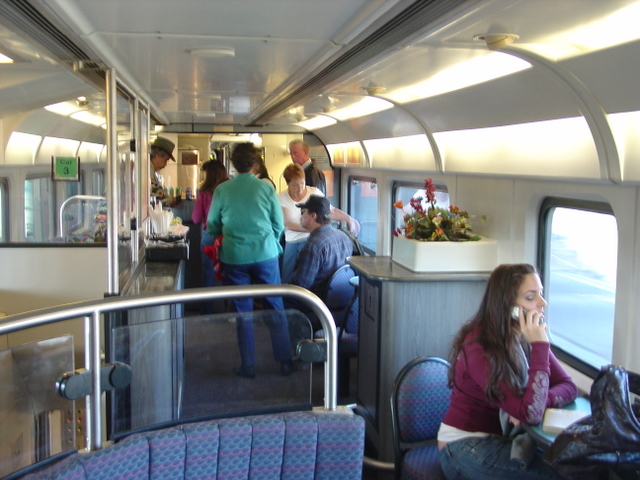
Above is AMTRAK Capitol Corridor, the regional/commuter train between Sacramento and San Jose. The interior is lovely and comfortable (and these trains have great ridership, despite the picture.) This certainly seems like a basic level of quality we can apply to any regional or commuter train: plush seats, a seat for everyone under normal commute conditions, cleanliness, soft lighting, and officials on board to enforce good behavior and help people. Capitol Corridor also features a snack car that sells coffee, beer, and basic food. Whether AMTRAK makes any money on this or loses money doesn't really matter--it's a really nice feature to have on any kind of transit:


Subways, including BART, which functions as both a regional train and metro, typically lack everything described above. Why is that? There are some subway routes that are packed downtown. There's simply no way to run enough trains to give everyone a seat at the downtown stations, nor does anyone really need a seat to go three stops downtown. That suggests to me that subway cars should probably be configured for people traveling long distances and for people doing short hops. Boston's Red Line implemented Big Red trains with standing room only and positions them as the middle cars of trains during commute hours. I would agree with their strategy if they were actually meant for short-hop travelers downtown, but they were really implemented to cram more people into the trains at rush hour, whether they are traveling thirty minutes or five. What if we configured standing room-only cars in the middle of our subways but placed plush seats and cafe cars on the ends? Many trips on BART or subway in NYC are over thirty minutes in length, which makes the AMTRAK configuration (including restrooms) very practical. A cursory search for luxury subway cars leaves much to be desired. This was BMW's effort at a luxurious recyclable subway in Poland:


It advertises soft lighting, individually-controlled climate control per car, and wide doors. It looks much more like the subway cars I already know than a comfortable sitting space with amenities.

I think what we need to do is to start treating our subways with the same type of grandeur that used to be applied to passenger trains. It doesn't require caviar nor private compartments, it just means taking the practical comforts of trains and adapting them to the size and larger passenger loads on subways. It's a two-way street--make the subway more like a comfortable train car and reduce the overcrowding and arbitrary mixing of short and long-haul riders in each car. It of course requires running higher frequencies, new cars, on board attendants, expanding networks--in short spending a lot more money on capital and operational costs. But we need to do many of those things anyway just to make transit usable. Let's get the cost and efficiency numbers in the right neighborhood, but then let's "waste" some money on grandeur. We might be surprised at what it does for the ridership numbers.

Tuesday, May 8, 2012

The silliness of UC Berkeley's vocalized bus turn alerts

On my bike route to the office this morning, I was delighted to hear a new UC Berkeley shuttle bus that services the university labs up in the hills announce by computer voice that it was turning. The message is something to the effect of "Pedestrians, bus is turning".

Here's the UC Berkeley announcement about the buses, where I left the following comment:


http://today.lbl.gov/2012/03/07/lab-shuttles-now-feature-safe-turn-alert-for-pedestrian/comment-page-1/#comment-593544

...The announcement begins while the bus in making the turn, so the only warning the pedestrian receives is the start of the word “pedestrians” before the bus is intersecting their path. If UC Berkeley wants to make the streets safer, it should support policies to pedestrianize streets and and reintroduce streetcars/lightrail to Berkeley, the only form of transit that is completely predictable. The Ecocity Builders have had a great plan to pedestrianize the single block of Center St. between campus and BART for years (http://ecocitybuilders.org/projects/current/center-street-plaza/).
As an urban society, we continue to endure quick fixes that are useless to solving overarching problems. The reason that buses are dangerous is that they are unpredictable. As bikers we don't know when they are going to pull over to pick up passengers, unless we are familiar with all the stops. As bikers and pedestrians we don't know when they will turn, unless we are familiar with the route. They regularly play leap frog with bikers because our overall speeds match, leading to the biker passing the bus at a stop and the bus passing a biker on a long straightaway. Most of these problems would be solved with a dedicated transit right-of-way. The bus wouldn't pull over for stops, and it would be fairly obvious where it was turning unless there was a route junction.

I admit then that BRT (bus rapid transit), if it could be built to full BRT standards (it never is in this country), would remove a lot of the unpredictability and therefore danger of buses. The problem with BRT though, even with Class B right-of-way (dedicated lanes exposed to traffic at intersections), is that there remains an unsettling driver unpredictability. I'm sure that bus drivers with their own lanes drive better, especially when the bus has to needle its way through a tunnel like the poor Boston MBTA Silver Line to the airport. But inevitably the driver has the ability to accelerate to make green lights or to speed up and slow to keep with their schedule. The best we can do is to reduce to variability of our surface transit vehicles by simply putting them on tracks on dedicated lanes in the street. Nobody ever has to worry about an aggressive streetcar or light rail driver, at least not in this century. The vehicles are technically capable and should always travel at the exact same speed through each segment of their route. They must always make turns slowly due to their articulated body and the limiting characteristics of rail, making it nearly impossible for a pedestrian or cyclist to be caught off-guard. BRT buses could have set speeds as well, but they typically leave the driver in control, both to save costs on technology and because the driver has to control the steering wheel of the bus anyway.

All of my posts on BRT versus light rail and the merits of pedestrianizing streets revolve around the same theme: We can't make decisions about transit modes and our use of streets with purely quantitative reasoning. The reason to pedestrianize and use rail or bus has numerous qualitative benefits that require detailed discussion.

Friday, August 14, 2009

Rebutting the typical bus improvement ideas

I've read thoughtful articles about improving the efficiency of certain bus lines. I took the crawling AC Transit 51 line home from Berkeley to my house in Oakland Wednesday night. I was annoyed by the usual slowdowns from traffic lights, stop signs, and bus stops that occur frequently. It lead me to look up a blog post that someone wrote about improving the line: http://oaklandliving.wordpress.com/2009/03/17/ac-transits-ideas-for-making-the-51-faster-and-more-reliable/
The post is very thorough and well thought out. It references meetings about the lines and all kinds of possible improvements--removing stops, creating more space for stops, splitting the line in half, allowing rear door entry, etc., and says that a BRT system would be the best fix, with some caveats:
Now the 51 line is of course not the same as the 1 line. For starters, College Avenue will never have rapid service because it’s difficult for buses to pass each other and there’s often near stopped traffic for several blocks. But for the rest of the line, particularly along Broadway and University, which have several traffic lanes, rapid buses could move very quickly. Really, this is the type of service I dream of. Unfortunately, this option got just three paragraphs of attention in the report, which makes me concerned that ACT isn’t taking this option seriously. I hope that changes.
Never have rapid service? That is where I stray from mainstream thinking, where people talk in terms of bandade style fixes to a broken transit. The writer refers to College Avenue, which is a great street full of restaurants and student housing and stretches south from the UC Berkeley Campus through the neighborhoods of Elmwood and Rockridge, both loaded with residents, shoppers, and diners. The housing surrounding is in the highest demand, even after the housing bust. The bus is atrocious on College Ave because the traffic is stop-and-go, and several intersections have heavy cross traffic, which means slow traffic light periods and minutes of delay when vehicles pile up at lights or stop signs. Neither buses nor cars belong on this street. It's a couple miles long, wonderfully walkable, and Telegraph Avenue parallels it a few blocks away and mostly has four lanes for traffic (though they are serious about taking two lanes for BRT there, as indicated in the quote.) People who drive on College Ave are usually going from or too somewhere on the street, not using it as a thruway. What College Ave needs to be is a non-asphalt walking surface with either a nice streetcar down the middle or maneuverable metro system that goes underneath. I prefer the metro because the streetcars that I've seen on pedestrian streets are rather slow, and I want effective transit for the entire 51 line.

I'm going to diagram the 51 line and a reworked College Ave here because it really is a perfect candidate for car-free neighborhoods and a vastly improved transit line. First, a look at the north end of the line. It begins at the water at the Berkeley Amtrak station and the 4th Street shopping district, which is a popular upscale area that is mostly accessed via car (reasonable assumption.) The line then heads east to downtown Berkeley where it meets the main Berkeley BART station and passes around the perimeter of the busiest part of the UC Berkeley campus. It then continues south down our featured College Ave, meets another BART line in Rockridge (where it intersects Hwy 24) and shortly after goes down Broadway to downtown Oakland. I've omitted the part of the line in downtown Oakland and the city of Alameda because from Rockridge to BART parallels the bus, making it less important, and Alameda can be considered a different line that is responsible for connecting Alameda with the downtown Oakland BART stations.

In case you didn't notice, this is a snapshot of a realtime map showing the stops with red dots and the positions of the buses and their directions. I snapped this on Saturday morning when the service is sparse.

http://www.nextbus.com/googleMap/googleMap.jsp?a=actransit&r=51&d=51_246_1&s=36

Here is a Google Map showing my proposed Metro:


Costs/Benefits

To get a general idea of the cost of such a system. I consulted Wikipedia's metro and light rail articles. It turns out if you make the system a combination of light rail on the wide streets and street car on the narrow streets then the system fits existing light rail implementations, such as Calgary's in Canada. According to the Wikipedia Light Rail Article the Calgary system cost around $24 million per mile. The operating cost per mile are $163 per train per mile. Since the main part of my route is 5 miles we could have a capital cost of $121 million (the optional part to Oakland makes it 7-8 miles.) I know from personal experience that Calgary's light rail does a bit of tunneling, and we would have to do the same for at least a quarter mile through downtown Berkeley and consider the cost similar. Calgary's costs are on the low end because they leased a lot of rail right of way, but in our case we're taking existing street, which is free. Now, to implement the ideal solution with the track underground from downtown Berkeley to Rockridge there would be a considerable extra cost. Nevertheless Berkeley's residents agreed to pay a surcharge of $18 million in 1969 ($104.6 million in 2008 dollars) to make all of BART underground in Berkeley (part was already going to be underground.) Since the metro from downtown Berkeley to Rockridge is the same distance as the BART track through Berkeley, we can argue that the extra cost of tunneling would be around $100 million, giving a total capital cost of $221 million.

The more I think about it the more I prefer to keep the system above ground, despite the potential slow downs, because it gives a good excuse for clearing cars of College Ave and fully pedestrianizing it. Here's a very amateur model using Sketchup and a Google Earth image of the College Ave. and Claremont Ave. intersection. I thought it might be useful to take advantage of the extra space provided by an intersection to put a tram stop and allow trams to pass if there was only room for one track along the street. I think a well-automated system could handle this configuration well. If a single track had a station with double track every quarter or half mile then the trams could make efficient use of the street. I'm not sure what to do about a break down, which is why it's likely better to have double track throughout. Perhaps there would be double track throughout and the tram would only use one track and split at stations, as below, but the second track would be on a car/truck lane and could be used for emergencies, or at times when cars and trucks were disallowed.


And just to keep things in reality, here's an image of the trams in Montpellier, France:


Monday, February 21, 2011

The lack of high-profile local transit advocacy groups

When considering advocacy power, one needs to consider two dimensions about its advocates--whether their geographic (or perhaps socio-economic) situation is dispersed versus concentrated and whether the issue of interest has a narrow or broad scope. For transit systems, the users tend to be dispersed geographically, unless the transit system is limited to one line of service. The importance of the transit system has fairly narrow focus for most transit users, because they rely on it to get to and from work in a timely matter, but it is broad in that people have different ideas about what it lacks. The most powerful advocates tend to be concentrated with narrow focus.

The MBTA in Boston is used by a broad group of users of every socio-economic background. The decline of transit over much of the 20th century has left MBTA riders with little in expectations of the system, even though it is essential to the metro area. Because of the low expectations and a geographically and socio-economically dispersed clientele, there is no strong advocacy group for the MBTA. The only group that I'm aware of is the T Riders Union, which tends to concente on the social justice problems, like cleaning up the bus fleets that are stored in poor neighborhoods. Boston should have a higher profile MBTA advocacy group, especially considering the highly educated population and business interests that rely on the transit network. Where is that group? Can advocates only rally around a certain transit project, like a line extension to their neighborhood? I'm happy to support any increase to MBTA funding that would result in expansion of the rail system. And I'm sure tens of thousands of people would join a group that lobbied for a better-funded MBTA. Here is the best link you can find on MBTA advocacy, the result of the good work of the T Riders Union, MASSPIRG, and the umbrella On The Move coalition.

It seems like we need a group narrowly focused on funding the MBTA to upgrade and expand the rail rapid transit and regional rail. This means serving current riders, from rich to poor, by upgrading bus lines to modern streetcars/light rail with dedicated lanes and signal priority, converting the commuter system into a regional system (frequent and electified service), and fighting to extract money from driving and parking to put into the system. Now, how can I get that started?

Calling on advocates for:
  • Modernization and expansion of the MBTA rail network.
  • Upgrade of many bus lines to streetcar/light rail on dedicated right-of-way with signal priority.
  • Rejection of BRT (bus rapid transit) and fake BRT (i.e. MBTA's Silver Line) in favor of rail transit.
  • Institution of major new funding sources for the MBTA to be extracted from driving and parking to simultaneously encourage transit use and discourage driving.
That seems pretty narrow in scope and highly desirable for many people.

Monday, April 4, 2011

Follow up to "The lack of high-profile transit advocacy groups"

I turned my post on high-profile transit advocacy groups into a class paper:

 A new group for MBTA advocacy

Andy Likuski
Graduate Student of Tufts Department of Urban and Environmental Policy and Planning
March 15, 2011

The MBTA in Boston is used by a broad group of users of every socio-economic background. The decline of transit over much of the twentieth century has left MBTA riders with relatively little in expectations of the system, even though it is essential to the metro area. Perhaps because of low expectations and the idea that the T is barely “hanging on”, not to mention the problems of dispersed users and interests, there is no strong advocacy group for the MBTA. The only group that I'm aware of is the T Riders Union, who along with groups like MASSPIRG (under the umbrella On The Move coalition), tends to concentrate on stable funding, social justice, and environment. Boston needs a higher profile MBTA advocacy group, especially considering the well-educated population and business interests that rely on the transit network. Where is that group?

When considering advocacy power, one needs to consider two dimensions about the advocates. First, their geographic (or perhaps socio-economic) situation may be dispersed or concentrated, where higher concentration draws more power. Second, power corresponds to the narrowness of the issue: A precise cause for action is easier to support than a broad one. For large metropolitan transit systems, the users tend to be dispersed geographically and socio-economically. But for many who commute with it, the transit system is heavily relied upon for a narrow purpose. Even those who use it more recreationally expect reliability and reasonable frequency, if not a comprehensive network. A successful transit advocacy group would thus need a simple and narrow goal that captured a large percentage of riders’ interests, but it would necessarily be a flavor of solution most appealing to the more politically influential users. I believe that a group that fought for comprehensive expansion and modernization of the rail network would meet those criteria; it would appeal to a wide spectrum of riders but would be important and thrilling enough to win the activism efforts of the more affluent, educated, or passionate users.

More specifically, we need a group narrowly focused on large scale funding increases to the MBTA to upgrade and expand the rail rapid transit and regional rail to modern international standards. Most everyone who uses the system could rally behind upgrading bus lines to subway or light rail that runs on dedicated right-of-way with signal priority, as well as converting the commuter trains into a regional system with frequent and electrified service. A smaller, but still significant number, would agree that the best (and only) source of significant stable funding is through targeting the under-priced cost of car ownership, driving, and parking, which happens to extract enormous amounts of money from the local economy to buy fuel.

The simple manifesto of this new group would thus be the following:


  • Modernization and expansion of the MBTA rail network.
  • Upgrade of many bus lines to light rail on dedicated right-of-way with signal priority without compromising to bus rapid transit (BRT) solutions.
  • Institution of major new, stable funding sources for the MBTA to be extracted from car registration, driving, and parking to convert significant car trips to transit via a double incentive and keep enormous sums of money in the local economy.

My exclusion of BRT is largely due to widespread and justified anger over the Silver Lines, but also because with adequate funding rail is the more appealing mode. The car-based funding mechanism is the most controversial bullet point, so much so that it is often precluded from transit funding discussions in favor of analyzing in minutia how riders might better support the system themselves and how value capture techniques, such as sale of development rights around new stations and assessment fees, might solve the funding problem. User fees should only be a minor part of transit funding and not be set according to the capital and operational needs of the system, but rather by what fee level is most likely to attract riders. In many cases where capacity can always meet demand, the most efficient fare is a high discount multi-use pass or no fare at all. Property assessment fees have some appeal, but that would diminish in poor neighborhoods where little new value can be generated, plus achieving system-wide improvements would dilute property appreciation in individual neighborhoods. For these reasons, car use is the best untapped source of funding for transit.

The group’s goal would not be to appease drivers with shared space solutions, but to present a unified front against driving as the dominant mode in the metro area. Although many potential members of the group would be part-time drivers themselves, the group’s simple message that driving must decrease and transit increase via a funding shift would still capture many part-time drivers who would be happy to drive less if there were alternatives. There is a large group of mixed mode users who would support a funding shift in order to decrease their own driving and that of others--citing stress, unproductive time, expense, and environmental harm as their motivations. Furthermore, the argument that our energy expenses need to stay in the domestic economy is one that straddles the spectrum of political ideologies.

Implementation

To launch a successful MBTA advocacy group with the given manifesto, I would foremost have to determine the best policy approaches for the group and social marketing to build its membership. In terms of policy scope, the group would work primarily at the local and regional level to increase fees for local car registration, parking permits, hourly parking, and eventually road use fees, to create a large transit fund. State-level work would be limited to policies that could target the metropolitan region without alienating disinterested parts of the state. All group members would be alerted to attend local government meetings to advance the group’s agenda, preceded or followed by social events to ensure high attendance. It would be essential to map the group’s manifesto to straightforward policy recommendations that any member could advocate coherently. Members with professional training in planning, policy, law, transportation, or similar skills would inject the group’s policy into government at a more technical level. The exact policy methods to reach the group’s goals would require intense deliberation by the trained members.

To initially market the group, I would have to couple the manifesto with an enticing visualization of the group’s goals. There are already products, such as theFutureMBTA maps, which could serve as a basis for this purpose. An initial large postcard for the group would show a future map with the manifesto and direct people to the group’s web site. It would probably be adequate to have the initial group of members, say interested students of university planning departments, Livable Streets, and Boston Planner’s Network, etc., display the postcards when they ride the T and hand one out to anyone who took and interest. That, coupled with the usual social networking on the Internet, could launch the group.

A sample postcard with a modified map from http://futurembta.com/thefuturemaps/.

Effectiveness

When it comes to improving transit, especially at the expense of cars, the politics are extraordinarily complex. That is why a united group consisting of skilled advocates and riders-at-large is essential to reversing the impasse of transit funding in Boston. A large group armed with a simple, comprehensive message could demonstrate that the funding we need to finance transit expansion must come from cars. The group would present a closed-loop solution to provide steady capital and operational funds to the MBTA that would pass the scrutiny of leaders trying to make an under-financed government work. Without such an effort, the MBTA will remain at the brink of a financial meltdown and do little more than maintain service. We know that the barriers to improving the MBTA are in part financial but mostly political. Less wealthy countries have vastly improved city transit and today successfully extract large fees and taxes from auto users. A high level MBTA advocacy group could bring about a similar outcome here.

Thursday, August 6, 2009

MBTA Silver Line


As a follow up to my BRT post, I want to critique my current ride on Boston's fairly new airport connector. It leaves South Station, the main train station and goes to the airport, which is a great link to have. It begins underground with full right-of-way and runs on electricity. After that there is a brief above ground segment where the bus passes through a couple signals. I'm not sure if it has it's own lane there, but probably does. It does cross traffic at one light, unfortunately. The bus then tunnels on a nondedicated lane (running on diesel) and circles the airport gates.

Pros:
Almost predictable arrival time, but airport traffic could delay it.
Partially electric and partial right-of-way.
The fare is part of the rest of the T. This is crucial. You don't have to pay on the bus or pay separately from the trains. I really don't think there should be an airport surcharge like so many other cities have. The biggest payoff is preventing driving, not collecting revenue.

Cons:
Manually controlled on narrow right-of-way. That seems a little bit problematic.
At least one red light that crosses traffic, cresting a variable length trip.
Handicap users are inconvenienced by the usual special bus loading procedures. Special ramps on the platform could help this, but you still have to secure the passenger.
The bus stops to turn off the electric engine and start up the diesel motor.
It's still an uncomfortable bus.

To me this bus is an acceptable solution. I'm just as happy with it as the alternative blue line train that requires a short shuttle bus connection from the airport station. I do wonder why in both cases a subway couldn't go all the way to the airport. At worst it could come in on an elevated track. I guess I'll have to go check the planning documents.